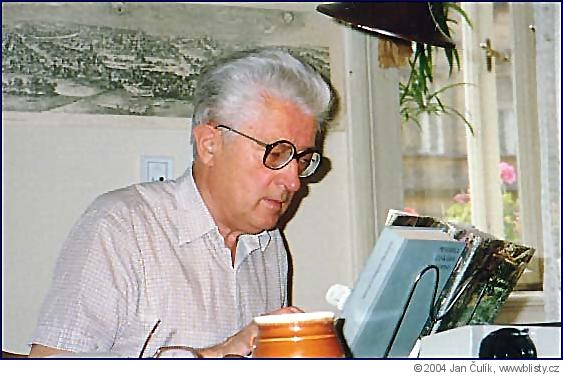
Edwin Muir, as remembered by one of his Prague students
14. 9. 2026
/
Jan Čulík st.
čas čtení
16 minut
This paper was originally published in the volume Scotland and the Slavs: Selected Papers from the Glasgow '90 East-West Forum, Nottingham, England : Astra Press, 1993..
Edwin Muir spent three years in Prague shortly after the war
as a professor at Charles University and as director of the British Council. I
had the honour to be his pupil. He certainly belonged among those serene
personalities whose influence I deeply felt not only in my formative years, but
even much later.
1945 was a watershed year for Czechoslovakia. For our
country, the war ended on 5th of May, but the American army was not permitted
to enter the capital because General Eisenhower was afraid that a swift advance
by the Americans would antagonize Stalin. It had been agreed that Prague would
be liberated by the Russians. On the 9th of May, the Soviet soldiers finally
appeared in Prague after a long march from Berlin. What was called the Prague
Uprising started on 5th of May 1945. The turmoil lasted for a few days and then
subsided as the Germans gradually withdrew from the city.

In one or two weeks I found myself at the Faculty of Arts
moving furniture and sorting out books, for the university building occupied by
the Germans to the last minute had served as the Nazi police or SS
headquarters.
The place was now returning after nearly six years to its
former academic use, and the first lectures of the extra summer semester were
to be given as early as June, irrespective of the summer vacations.
The atmosphere in those days was unique. The number of
students wishing to study philosophy, medicine, law or theology was practically
unlimited. There were no prescribed quotas, no entry examinations as now. There
were no obstacles whatever to anyone who was eager to gain knowledge at the
Alma Mater Carolina. All you had to do was to choose the lectures or seminars
you were interested in, write them in your undergraduate's Index lectionum, pay
a very low fee of five Czech crowns, and have the list signed and
rubber-stamped by the dean.
As a result, all the lectures in the summer semester were hopelessly
oversubscribed. There were all kinds of people, young and old, attending these
lectures. I even recall seeing an elderly verger from a Catholic church in
Prague at one of the classes. He had obviously decided to study Latin in order
to understand the Mass.
When an old professor of philosophy who before the war had
been having only a few students entered the faculty's largest lecture theatre,
which was packed with people sitting not only on the stairs but even hanging
from the window frames, he paused in wonder and said, good heavens, I've never
seen anything like this in my life.
These activities are wonderfully captured in Edwin Muir's
autobiography:
“My lectures brought me in contact with a great number of
young Czechs. Most of them were poor and working at various jobs, as well as
attending the university. They had been idle by compulsion during the
occupation, and now they never seemed to rest from morning to night. They
appeared to believe that the good lives consisted solely in hard work. Perhaps
they had been encouraged in this by old Masaryk. a remarkable but pragmatically
moral man. I suggested that if they worked all the time, they would have no
time left to thinking. But they did not take my words seriously. They read and
read, wrote and wrote, worked and worked, in a continuous fury. Perhaps they
were half aware already of history behind them driving them on, and history in
front, warning them that they might have very little time to do what they
wanted to do.”
Fortunately, the initial enthusiasm didn't last long and had
almost completely waned by the time the students were expected to sit
examinations. Already by the second winter semester, student attendances were
more or less back to normal levels.
The British Council, headed by Edwin Muir, must have been
established as early as the summer months of 1945. In the list of lectures for
the winter semester in my index, I find the entry Edwin Muir, English
Literature 2 hours a week, which is evidence that he began to teach at the
university in October 1945.
I knew Edwin Muir from my regular almost daily visits to the
British Council, and I welcomed the opportunity of hearing him speak even
though I did not understand all he was saying and was not able to appreciate
his fine and sophisticated explanations. Indeed, there were very few students who
could. One is not very philosophical at the age of twenty. That was also
probably the reason why Edwin Muir's lectures were much less packed than the
rest.
While Edwin Muir appeared at the Faculty of Arts only
occasionally, mainly to give his lectures and seminars, the British Council
housed in the beautiful 18th century Kaunic Palace in the center of Prague was
his kingdom where he was a well-known and I suppose also a well-loved figure.
The building contained a great many rooms, the largest
probably being the main hall with rows of chairs, period furniture and the
grand piano. The second largest room was the library. There was also a small
kitchen where you could get a free cup of tea with biscuits and naturally there
were one or two classrooms.
The staff were very friendly and helpful. I found there,
still during 1948, shortly before the library was closed, many books I needed
for my doctoral thesis, the Masters of Paradox in Modern English Literature,
dealing mainly with Oscar Wilde, Bernard Shaw and G. K. Chesterton.
The evening hours at the British Council were devoted to
lectures or talks, to music recitals, rehearsals of plays, or parties with
parlour games and of course to classes in English.
One of the readings which made a deep impression on me was
that of an English translation of Mácha´s Máj by a young Scottish poet whose
name was McGovern. Máj, which is Czech
for May, is a fairly long romantic lyrical epic poem written in the first half
of the 19th century by Kaerl Hynek Mácha. It belongs amongst the finest
treasures of Czech literature.
McGovern was a typical Byronic figure. He had been held in
the Nazi concentration camp of Buchenwald, where he had learned some Czech and
had come to know Mácha´s Máj, probably through fellow prisoner Professor Vočadlo.
He liked the poem so
much that he had translated it into English and recited it that night by heart
in the main hall of the British Council residence. I thought it a great
achievement, both from the viewpoint of his memory, the recitation took almost two
hours, and the translation skill, for the poem is far from easy to understand,
let alone translate.
Another, perhaps less solemn and more relaxed occasion, was
the reading of Sheridan's play The Rivals. The performers were the teaching
staff of the British Council with Edwin and Willa Muir in the leading roles.
The cast were all sitting against the front wall of the main hall, each holding
a copy of Sheridan's comedy in their hands and acting, that is, reading their
particular roles to the best of their abilities.
Although the rendition was probably fairly basic, at the
time it gave everyone a lot of pleasure and promoted gales of laughter. The
greatest success was Willa Muir in the role of Mrs. Malaprop with her
unintentional misuse of words.
To the casual onlooker, the Muirs were an incongruous
couple. She seemed indeed a very robust matter of fact lady, the very opposite
of her husband, both psychologically and physically. He was a thin,
introverted, impractical, bespectacled intellectual, rather inconspicuous,
almost shy. His suits were midway between looking old-fashioned and shabby, but
one should not forget that those were the first post-war years when good
clothing was in short supply.
Anyway, he was certainly more than the outer appearance
would disclose. He always spoke in a very quiet voice, but was an extremely
good observer. To hold a supercilious attitude towards others was something
unknown to him.
When comparing the two, one would be inclined to say that
Edwin Muir must have been a little hand-pecked. Yet this was obviously a false
impression. In fact, somehow they must have needed and complemented each other
in a deeper sense than a superficial eye could appreciate.
Edwin Muir was a wise man radiating goodness. I never saw
him angry. He was kind and modest, showing no signs of snobbery. whatsoever and
displaying a highly developed sense of humour which constantly seemed to
twinkle in his eyes.
In July 1946, the British Council organised a summer school
at Litomyšl, an ancient historical town in East Bohemia. Some fifty students
attended it and a skeleton of Edwin Muir's staff. There were classes in English
language, literature and history and British life and institutions. We learned
a number of English and Scottish songs which I remember to this day.
There were informal discussions on various subjects during
breaks between classes, at lunch and at dinner time. Edwin Muir would come and
sit at our table in the dining hall and talk to everyone.
The summer school presented the British in a very good
light. It helped to correct the misconceptions of uncritical people who
sentimentally adored everything English while dispelling the prejudices of
those who disliked it.
When I look up my Index
lectionum, I find two more entries bearing Muir's name, a seminar on 19th
century English poetry given in the second-half of 1947 and early 1948, then
after February 1948 when the Communists took over a series of lectures on 19th
century English literature.
These lectures were the last course Edwin Muir delivered on
the grounds of Charles University. The entry in my index remains unsigned as he
had to quit lecturing before the end of the summer semester.
In his autobiography, his recollections refer exactly to the
new situation which arose in those early days of totalitarian rule:
“ All was changed. My class, once eager to discuss
everything, was silent. Two communists were in attendance, talking down what I
said. I could speak to my class, but I no longer had any contact with it. Yet
in spite of this, I felt in a privileged position compared with the Czech
professors and lecturers who were in the employment of the state. I did not try
therefore to modify the tone of my lectures to suit the new demands. I was
ploughing through the Victorian age at the time, and when I came to John Stuart
Mill, I gave my students a summary of his ideas on liberty. The two communists
grew agitated. The students seemed to be fearfully enjoying a forbidden
pleasure. I felt them coming to life again, but it was a temporary revival. The
class quickly dwindled. (p. 272).”
What Edwin Muir says here is true. Of the three professors
in the English department, only Otokar Vočadlo did not lose face. When I set my
final examination with him late in 1949, more than a year after the communist
coup, he asked me to explain the meaning of the words freedom and liberty.
Despite the communist informers who sat there to report on him, he pointed out
to me that liberty was to be understood primarily in the political sense. He
added that his friends when he had been leaving London the last time, had told
him with the utmost urgency, “Keep your liberties, keep your liberties”.
Soon, Professor Vočadlo was sacked from the university. He
was not able to return to his post until 19 years later in 1968, when I was the
first to sit my doctoral examination with him, which was, of course, a very
moving occasion. Not long after the Soviet invasion, Vočadlo was dismissed
again and died a few years later. He lived in seclusion, but the regime never
broke him.
The worst case was that of Professor Zdenek Vančura, who was
a promising scholar but not a person of moral strength. Very soon after the
communist takeover, he decided to go with the tide and made a point of
specializing in socialist and communist American and British writers. When I
tried to present my thesis to him in 1950, he shouted at me, insisting that I
quote Marx, Lenin and Stalin. I replied I had no reason to do so, slammed the
door of his study behind me, never to see him again. He died in the mid-60s.
A similar situation prevailed in all the other departments
of the university. Those who did not conform were purged. Those who did were
only able to retain their positions as subservient mouthpieces of totalitarian
ideology. Many such conformists are in post to this very day.
As a young student, I was unable fully to realize what Muir
stood for and what he believed in. I only knew what I saw, his manners, his
speech, his relationships with his students and his colleagues, his attachments
to his wife. One felt that he was a fine man in whom there was barely a trace
of evil.
Now that controversial values of the past are being
re-examined and reassessed, when former pluses are changing to minuses and vice
versa, Edwin Muir's beliefs suddenly stand out in sharp relief.
Fundamentally, he was a religious man. He maintained that
the demand of the divine law for unconditional reverence and unconditional
obedience is beyond question. He was constantly preoccupied with exploring the
meaning of life. Literature reflects society and life and can only be
understood when interpreted by a creative artist. He believed in what may be
termed a timeless archetypal story which is the source of all stories.
As a result, he seems to have observed things as though from
another level, from the viewpoint of eternity with a sort of detachment, as if
he were never completely committed to this world.
All this was a refreshing antidote to the Marxist babble
which began to resound in the lecture rooms. In contrast to the general
tendency to explain a work of art merely as a product of environmental
influences and external, especially political and ideological forces, Muir
always treated a literary work as an entity in itself.
In contradiction to the prevailing fashionable views, but
quite in line with the best traditions of pre-war Czech literary criticism, he
maintained that literature should express moral values and make meaningful
comment on life sub specie eternitatis.
In other words, that life and literature was not a
two-dimensional but a three or even multi-dimensional affair. But what
impressed me most when reading Edwin Muir's autobiography was his statement
that it is unnatural for human beings to act impersonally towards one
another, (p. 270).
This, I think, is one of Muir's essential ideas,
everlasting, highly compulsive because they are never fully recognized and are
constantly sinned against. It is a glorious equivalent to Kant's categorical
imperative, which says, to put it briefly, that every human being should be
treated by his fellow men not as a means to an end, but as an end in itself.
Prague had a particular attraction to the Muirs. They
visited it twice and seemed to have been impressed both by the good and the bad
experiences of their stay. In 1921, they lived in Prague for eight months,
mixed mainly with intellectuals, among them with the writer Karel Čapek and
learned some Czech. At that time, Czechoslovakia was an Arcadia compared to the
country the Muirs visited after the Second World War.
In 1945, Prague was a city scarred by war whose normal life
came after three years to an unhappy end. I wonder what Muir would have made of
the Prague Spring and the Russian occupation of 1968, or even the democratic
revolution in November last year with the controversial aftermath that we are
now witnessing.
If he visited Czechoslovakia at the present time, he would
certainly notice an unprecedented decline which has marked the people over the
past 40 years, turning them into socialist subhumans of a sort.
When Edwin Muir came to Prague in 1945, he managed to get
his institute up and running within one or two months. Now, almost a year after
the collapse of communist rule, the presence of the British Council in Prague
seems extremely shadowy. The then British Prime Minister said she wished that
English could become the first foreign language in Czechoslovakia.
Unfortunately to date, not much has been done to further this aim. The British
have a serious rival. At the moment, the Denis Institute has successfully been
working for months and the French are far ahead of the British in this respect.
We must have another Edwin Muir to run the British Institute along the lines it
functioned 45 years ago.
Notes:
1.
Edwin Muir autobiography, London 1954, p.262.
Further references are contained in the text.
2.
Introductory note to the Muse's translation of
Franz Kafka's The Castle: A Novel, London, 1930.
93

Diskuse